Planning guide
The carry deck crane vs forklift question usually arrives as a weight. We have a 30,000 pound press to move, what do we need. Weight is the wrong place to start.
Plenty of loads well inside a forklift’s rating have no business on forks, and plenty of loads a crane could lift are faster and cheaper to move with a forklift. The better question is how the load has to move.
Start with how the load is supported
Can it be picked up from underneath? If it has fork pockets, a stable base, and a centre of gravity that sits inside the truck’s envelope, a forklift is almost always quicker and cheaper.
If it has to come up on certified lifting lugs, because forks would point load a machined surface or crush a housing, that decides it. The load hangs from a hook and you need a crane.
Then ask whether it goes up and over
A forklift moves a load at low level along a floor. A crane lifts it over something. Setting a unit on a roof, dropping a motor onto an elevated platform, lifting a roll up into a machine, clearing a conveyor or a wall on the way through. Any of those need boom reach and hook height, and no forklift rating changes that.
The reverse holds too. If the load simply has to travel a hundred metres across a flat plant floor, a crane is the slower, more expensive and less stable way to do it.
Carry deck crane vs forklift at a glance


| The situation | Usually | Why |
|---|---|---|
| Fork pockets, flat floor, low level travel | Forklift | Faster, cheaper to staff, designed to travel under load |
| Lifts only on certified lugs | Carry deck crane | Forks would point load or crush the housing |
| Has to clear an obstruction | Carry deck crane | Needs boom reach and hook height |
| Set onto anchor bolts or dowels | Either | Crane slews and spots from above, forklift inches it from below |
| Low headroom bay | Depends | Compare the crane’s travel height against the forklift’s free lift |
| Heavy machine install | Both | Fork it in, crane it down onto the foundation |
Read both ratings honestly
This is where most of the trouble starts, because the two machines mislead you in different directions.
A crane’s capacity is a matrix, not a number. A 15 ton carry deck is a 15 ton machine at its shortest working radius with the outriggers fully deployed. Move the load out in radius and capacity falls steeply. Lift on rubber instead of on outriggers and it falls again, substantially. Slew the boom from over the rear to over the side and it falls again, because the machine’s tipping line is narrower that way. Riggers plan the worst point in the lift path, not the pick point, which is why a load that is safe boomed over the back can put a machine over if it is swung to the side without rechecking the chart.
A forklift’s capacity is quoted at one load centre. The rating assumes the load’s centre of gravity sits a standard 24 inches out from the fork face. Push it further out and capacity drops by simple leverage, roughly in proportion.
Safe capacity is approximately the rated load centre divided by the actual load centre, multiplied by rated capacity.
So a truck rated 40,000 lb at 24 inches handles closer to 34,300 lb at 28 inches. Lift height takes another bite, and attachments take another again.
A boom attachment on a forklift is the extreme version of this. It converts a forklift into a short reach crane for the odd pick, but the capacity penalty is large and the machine should be planned like a crane once the boom is on. On the ORION line the Quick Change system swaps attachments in about ten minutes, forks to boom, boom to coil prong, whichever way round, which makes carrying both to site practical rather than theoretical.
One genuinely useful trick sits on the Versa-Lift side. Those machines extend the frame to move the counterweight back, which gives the same truck a compact rating for threading through a plant and a much higher one for the pick itself. The model pages carry the figures for each.
Free lift is what decides a low headroom bay
Forklifts need height for the mast, and the number that matters is free lift. Free lift is how much height you get before the mast begins to extend upward. In a bay with a low ceiling, a pipe rack or a mezzanine overhead, it is the difference between making the lift and not.
Every forklift in our fleet has free lift. Across the ORION range it runs from roughly 13 inches on the smallest machines up to 50 inches on the 160K, so the larger the truck the more you get before the mast starts climbing.
Measure the lowest obstruction over the lift point before you specify anything, then work back to a machine whose free lift covers it.
Check the floor, and know whose job it is
This is the factor most often skipped on indoor work, and the one that does the most damage when it is wrong.
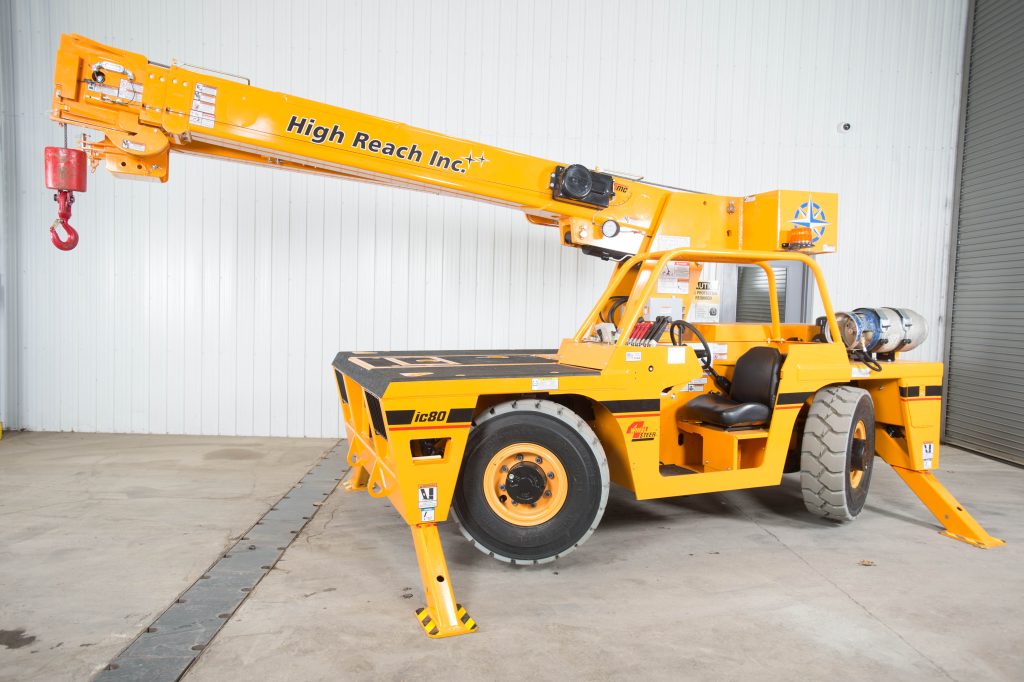
A crane on outriggers concentrates the whole machine, plus the load, plus the overturning moment, onto four small pads. When the boom swings over one corner, a large share of that can land on a single outrigger. The pressure under the pad is high enough to punch a slab or overload a mezzanine. Pads, float and timber dunnage exist to spread it, and indoors they are not optional extras.
A forklift spreads its weight over tire contact patches, which are larger. But it rolls that weight across the floor dynamically, with starts, stops and turns, and a heavy pick loads the front axle hard through two tires.
Neither is automatically safer. They are different load cases, and the responsibility for them splits cleanly.
The supplier gives you the ground pressure and outrigger loads for the specific machine, and we provide those on request. What your floor, slab or mezzanine will actually carry is a question for your lift planner or structural engineer, working from the building’s structural drawings.
The door usually decides it anyway
In plants, the deciding spec is frequently not capacity at all. It is whether the machine fits.
Carry deck cranes are built low and narrow for exactly this reason, and the smallest will pass through a standard equipment door and under a pipe rack where nothing else will.
Walk the route before you book anything. Narrowest door, lowest overhead obstruction, tightest corner, and the floor rating along the whole path rather than just at the pick.
Operators
Worth knowing, because it often decides the carry deck crane vs forklift question on cost alone. In Ontario a mobile crane rated over 16,000 lb needs a certified operator, which is a compulsory certified trade under Skilled Trades Ontario. Under that, no certificate is required. A lift truck of any capacity is operated by a competent, properly trained worker, which most plants already have on staff.
For a lift that can legally and safely be done with a forklift, that difference is often larger than the gap in rental rates.
Often the answer is both
Large machinery installs routinely use both machines in sequence. A Versa-Lift or an ORION takes the machine off the truck and walks it into the bay. A carry deck crane makes the final vertical set onto the foundation and the anchor bolts. Press moves, roll changes and turbine work tend to follow the same pattern.
The incremental rental on the second machine is usually small next to the cost of improvising the lift with the wrong one.
We run both lines, so the answer comes from the lift
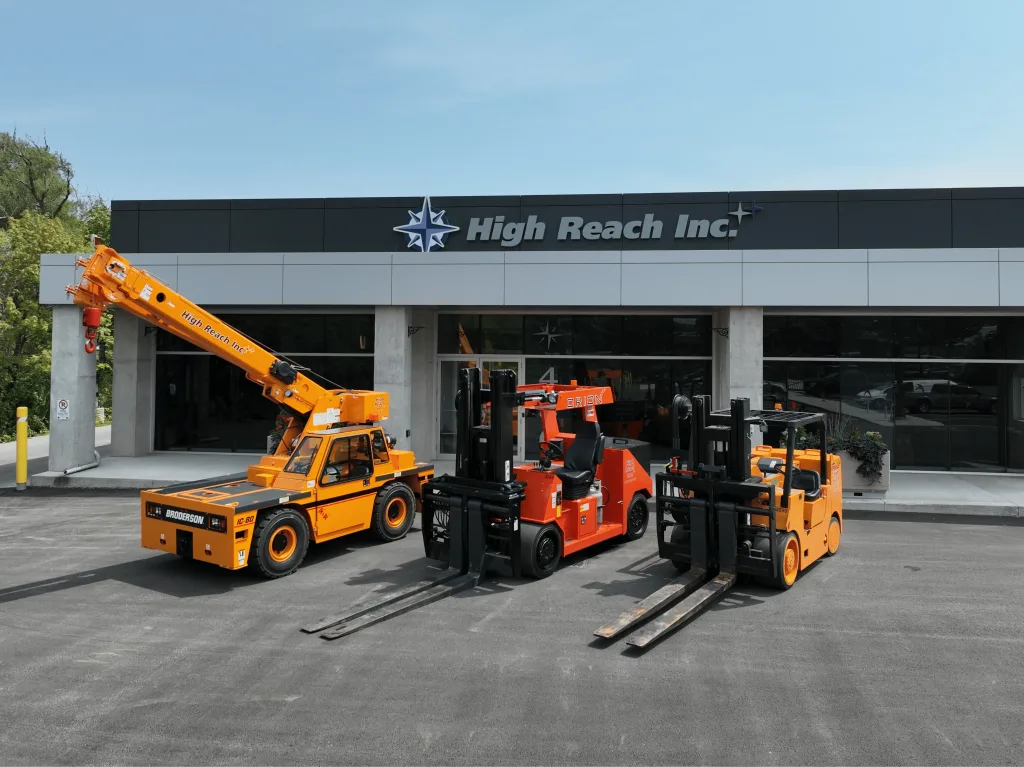
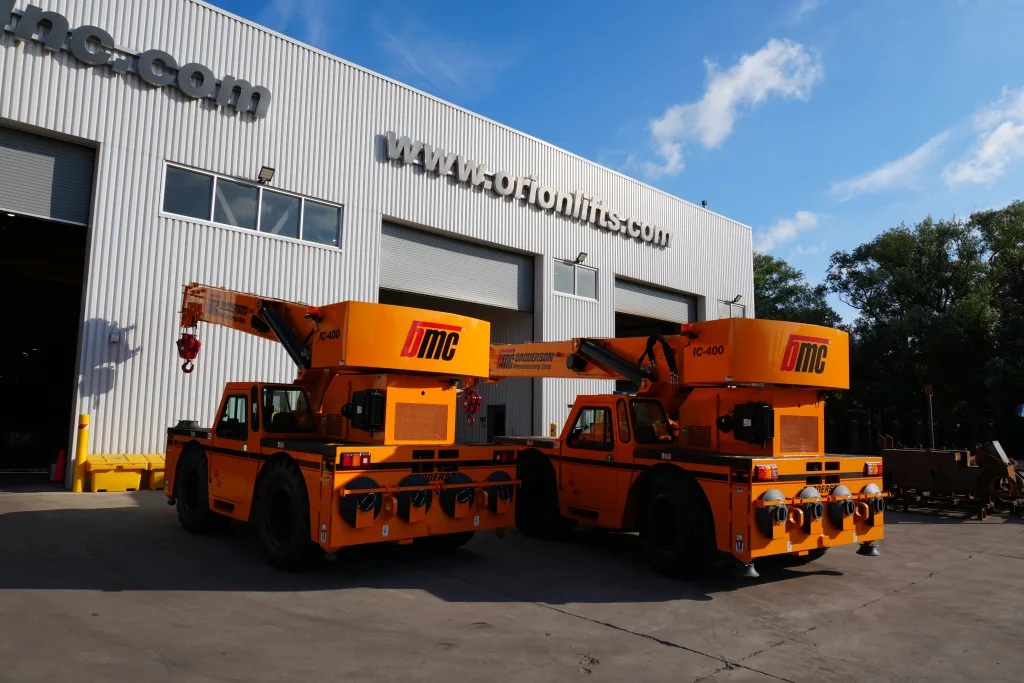
Broderson carry deck cranes from 2.5 to 25 ton, and high-capacity forklifts to 160,000 lb including the ORION line we build in Oakville. Send us the load weight, the lifting points and the route, and we will tell you which machines fit and give you the ground pressure figures your lift planner needs.
High Reach Inc. · 480 Wyecroft Rd, Oakville, ON L6K 2G7