It is 2 PM on a Tuesday. Your 60,000 lb stamping machine seizes up mid-production cycle, and the part is stuck inside. You have a four-hour window to move the entire machine off the line, extract the part, and reassemble everything before the next shift starts. Your standard facility forklifts max out at 12,000 lbs. You need a 120,000 lb capacity forklift on site by 3 PM.
This is the moment when emergency heavy equipment rental stops being a line item in a contingency plan and becomes the only thing standing between you and six figures of lost production. For Canadian manufacturers running heavy industrial operations, these situations are not hypothetical. They happen, and when they do, the speed and capability of your equipment rental partner determines how much the failure ultimately costs.
Real-World Scenarios Where You Need Emergency Heavy Equipment
These are not theoretical edge cases. They occur regularly across heavy manufacturing, and each one shares the same defining feature, which is that standard facility equipment cannot resolve the problem fast enough.
Critical Machine Failure on the Production Line
A piece of production equipment weighing 40,000 lbs or more breaks down mid-shift and needs to be moved off the critical path immediately. Your facility forklifts cannot handle the weight, and every hour of downtime can represent fifty thousand dollars or more in lost production. The solution is a high-capacity forklift on site the same day to lift and relocate the machine for repair, clearing the line so production can resume.
Equipment Replacement That Cannot Wait
New machinery arrives, but the equipment it replaces is heavier than expected. You need to pull out a 75,000 lb stamping press to make room, and the installation was scheduled for this week with no flexibility to delay. A high-capacity forklift rented for one to two days moves the old equipment out and positions the new equipment, keeping your installation timeline intact.
Bearing Failure or Internal Damage During Operation
A bearing seizes on heavy machinery mid-cycle. The machine cannot be moved by hand or by standard equipment, and the extraction requires precision lifting to avoid causing further damage. This is where an ultra-high-capacity forklift paired with rigging expertise becomes essential, safely moving equipment in excess of 100,000 lbs without compounding the original failure.
Multi-Piece Assembly Repositioning
A large integrated assembly weighing 80,000 lbs or more needs to be repositioned for alignment checks. Standard equipment can handle the individual parts but not the assembled whole. A heavy-duty forklift lifts and repositions the entire assembly safely, allowing your team to complete alignment work without disassembly.
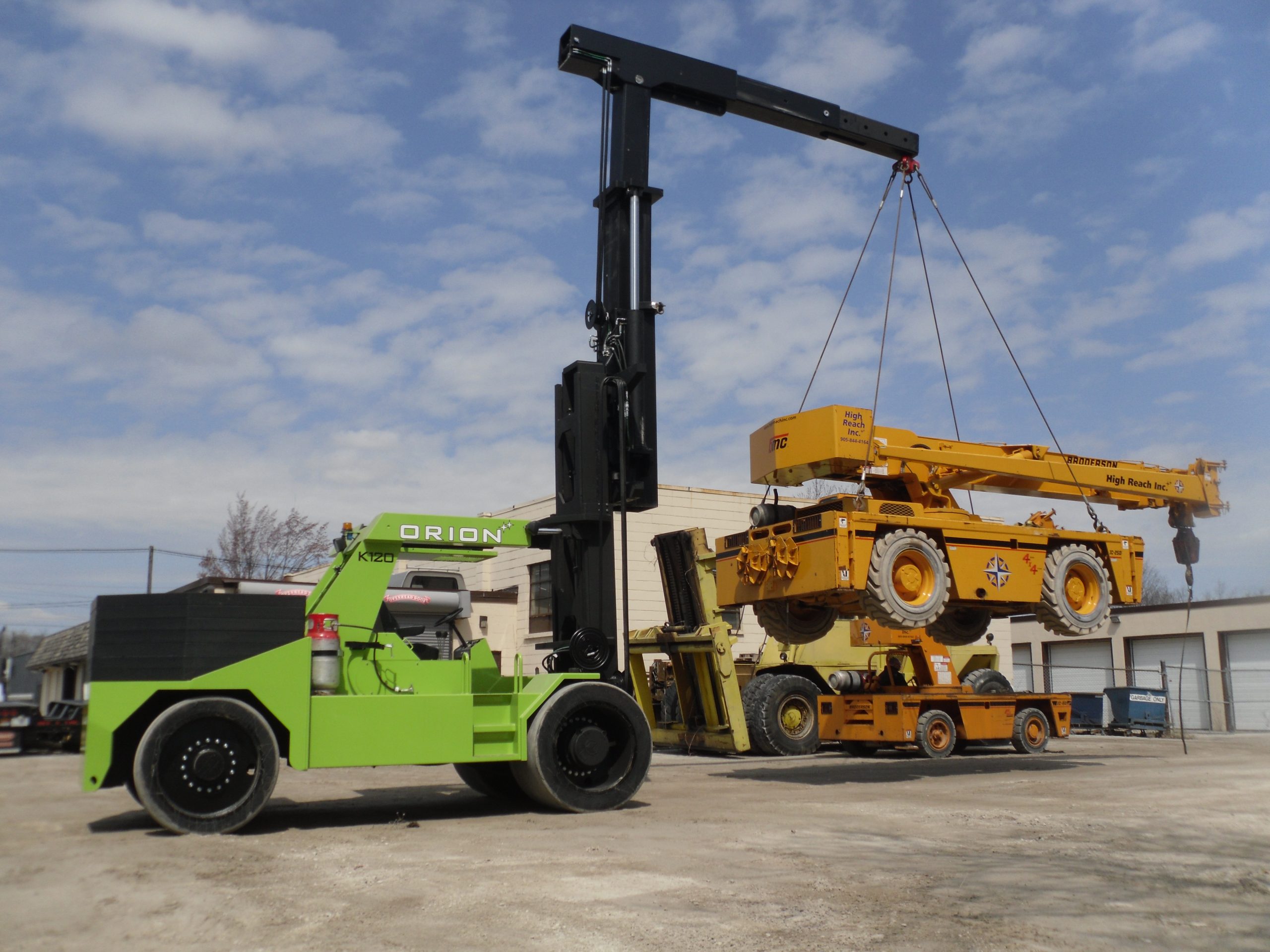
High-capacity ORION forklifts handle the heavy lifting that standard facility equipment cannot
Why Standard Forklift Rentals Do Not Work in an Emergency
When you call a national rental chain during a crisis, the response is often some version of the same sentence, which is that they can deliver in three to five days. Your reality is that you need the equipment in four hours or you lose two hundred thousand dollars in production. That gap is the entire problem.
The disconnect comes down to a few hard limitations:
- Most rental fleets do not stock equipment rated above 80,000 lbs, so the capacity you need simply is not in their inventory
- National providers are built around residential moves and small warehouse operations, not 160,000 lb industrial machines
- Specialized rigging expertise is rarely available, and almost never available outside business hours
- Backup equipment for critical operations does not exist in a general-purpose fleet
- Response time is measured in business days rather than hours
For a routine warehouse need, none of this matters. For a production line that is bleeding money by the hour, every one of these limitations becomes a direct cost.
What You Actually Need from an Emergency Equipment Provider
Not every rental provider is built to respond to a production emergency. The ones that can share four characteristics that matter far more in a crisis than the daily rate.
High-Capacity Inventory, Not General-Purpose Equipment
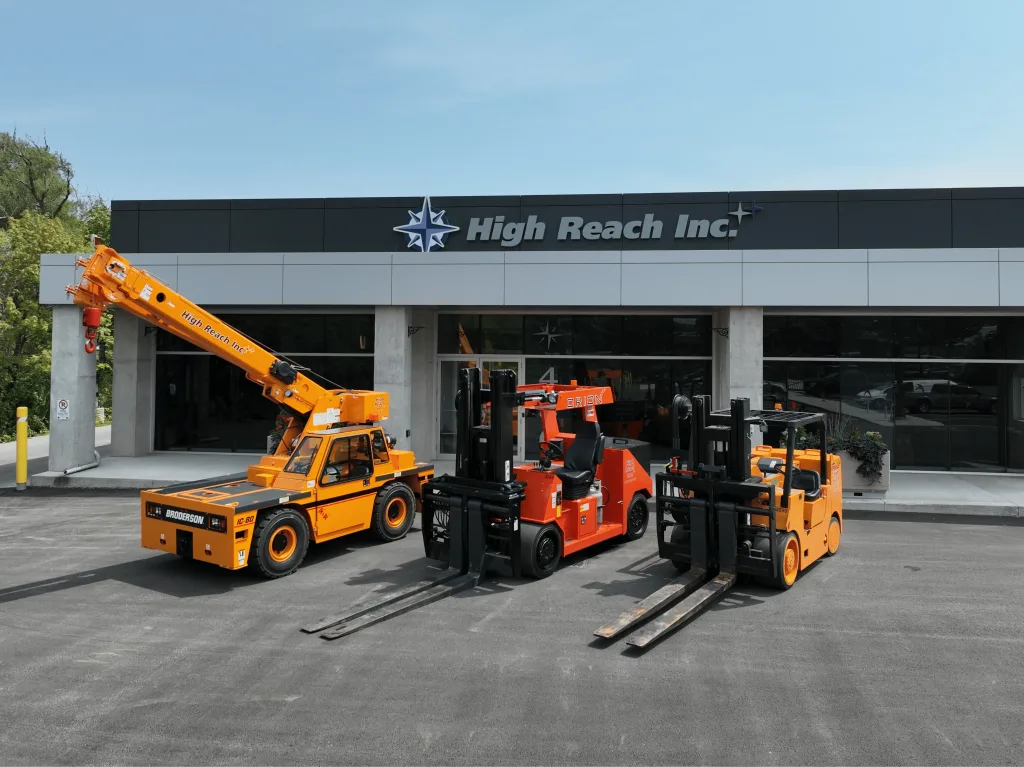
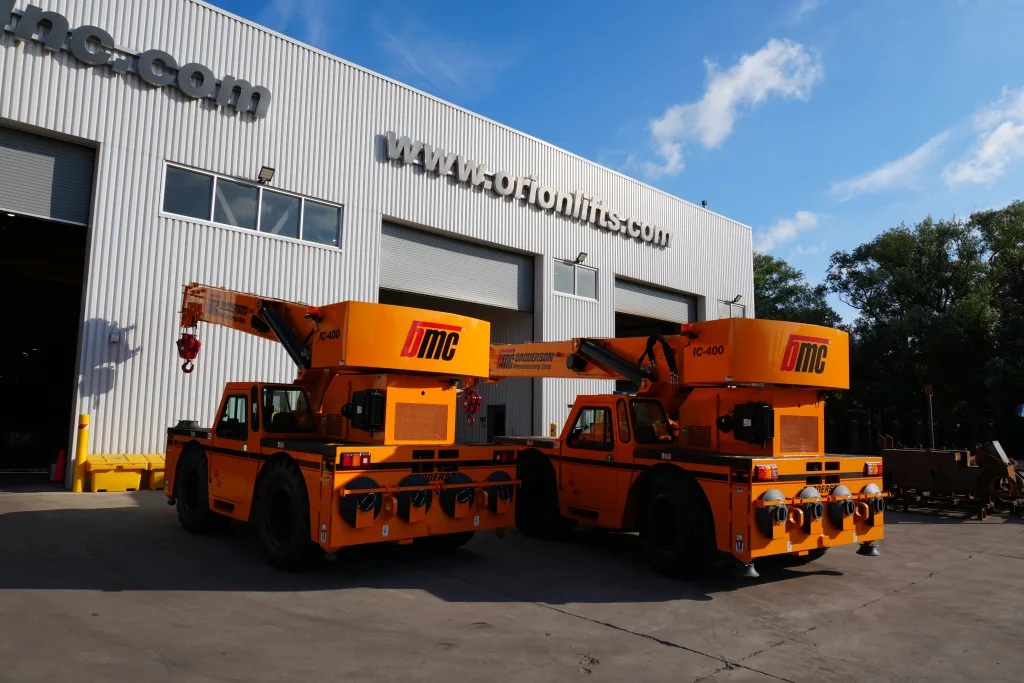
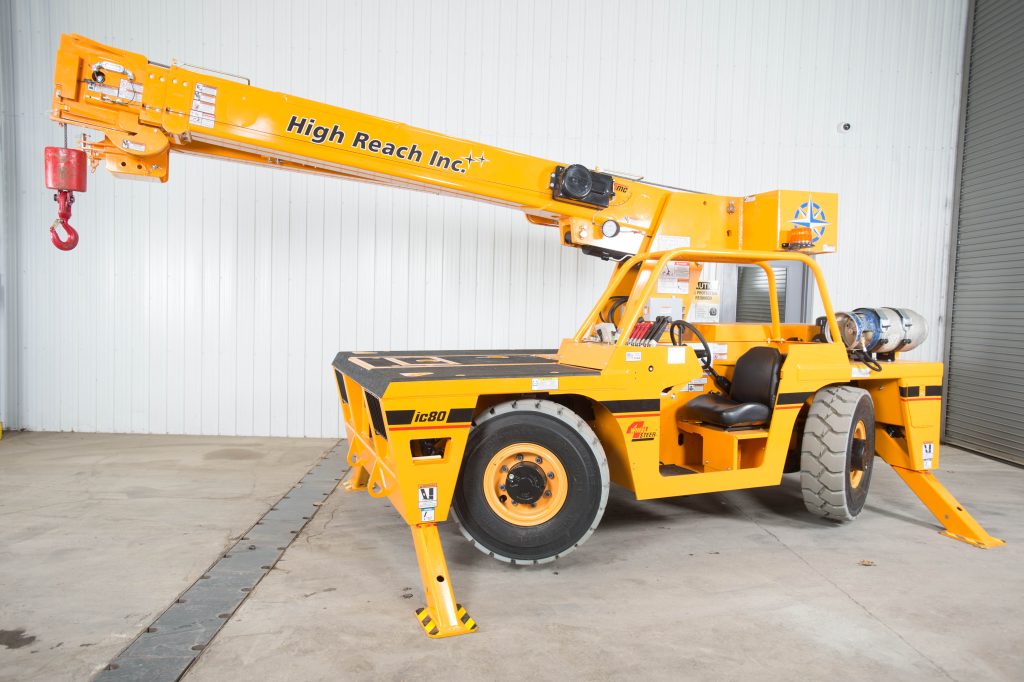
An emergency provider needs equipment built specifically for heavy industrial use. At High Reach, that means ORION forklifts rated up to 160,000 lbs to handle your heaviest equipment, Broderson cranes for rigging and positioning, and telehandlers for difficult access situations. This is purpose-built industrial capacity, not consumer-grade equipment stretched beyond its design limits.

A specialized high-capacity fleet means the equipment you need is ready when crisis strikes
Same-Day or Next-Morning Response
In an emergency, response time is everything. The right provider gets equipment on site within four to twenty-four hours, not three to five days, with a dedicated team standing by for emergency calls and after-hours dispatch available when failures happen overnight or on weekends.
Rigging Expertise Included
Your equipment is critical and often irreplaceable on short notice, which means you cannot afford mistakes during the move. Operators trained for precision positioning and support for complex rigging scenarios are not optional extras in emergency work. They are the difference between a clean extraction and a second, larger failure.
Full Liability Coverage
In a properly structured emergency rental, you do not bear the risk if something goes wrong during the lift. Equipment damage is covered by the rental company, and insurance is built into the rental rather than left as your exposure to manage in the middle of a crisis.
Questions to Ask Before You Need Emergency Equipment
The worst time to vet an emergency equipment provider is during an emergency. The best time is now, while the line is running and you have the luxury of asking questions and comparing answers. Establish the relationship before the crisis so the equipment is a phone call away when you need it.
Ask any prospective emergency provider these seven questions:
- Do you have 120,000 lb capacity equipment immediately available, and where is it physically located relative to our facility?
- What is your response time for after-hours emergency calls?
- Can you handle our specific equipment types, including stamping presses and spindle systems?
- Do you provide rigging expertise, or are we expected to coordinate our own rigging?
- If your equipment breaks down mid-operation, what is your backup protocol?
- Is liability and insurance included, or are we responsible for damage during the lift?
- Can you support the specific load and positioning requirements of our equipment?
The Cost of Waiting Versus the Cost of Emergency Rental
When you frame emergency rental against the cost of downtime, the economics become obvious almost immediately.
- A four-hour production stoppage typically represents fifty thousand to two hundred thousand dollars in lost revenue depending on the operation
- Same-day emergency equipment deployment typically runs two thousand to five thousand dollars
- The equipment rental effectively pays for itself within minutes of restoring production
This is why treating emergency rental as an insurance policy rather than a cost makes sense for any operation running high-value production. The rental is not the expense. The downtime is.
Plan Now for Emergencies
The manufacturers who weather equipment failures best are the ones who prepared for them before they happened. A small amount of planning now eliminates the scramble later.
- Identify your heaviest equipment and the maximum lifting capacity you would need to move it
- Map your equipment's critical path on the production line so you know what a failure actually halts
- Establish a relationship with a rental partner before a crisis, not during one
- Build emergency rental into your contingency budget so the spend is pre-approved
- Test the response time directly by calling and asking how fast they could reach you, before you ever need them
That last step is the most revealing. A provider's answer to a simple how-fast-could-you-get-here question tells you almost everything about whether they belong in your emergency plan.
Establish Your Emergency Rental Partner Before You Need One
When critical machinery fails, you do not have time to source equipment, compare providers, or negotiate terms. The work of finding the right partner has to happen before the crisis, not during it.
High Reach Inc. specializes in same-day heavy equipment rental for Canadian manufacturers. We maintain ORION forklifts up to 160,000 lbs, Broderson cranes, and the rigging expertise to handle your emergency safely. Contact us today to establish an emergency rental agreement, or call us when crisis strikes and we will respond fast.