Planning guide
Most people booking a carry deck crane settle capacity first, reach second, and fuel last if they think about it at all. For indoor work that order is backwards, and a dual fuel carry deck crane is often the machine that makes the job possible at all.
Fuel is the spec most likely to stop a job on arrival, and it is the first thing a plant’s health and safety people will ask about. It is also why a dual fuel carry deck crane is worth understanding before you need one rather than after.
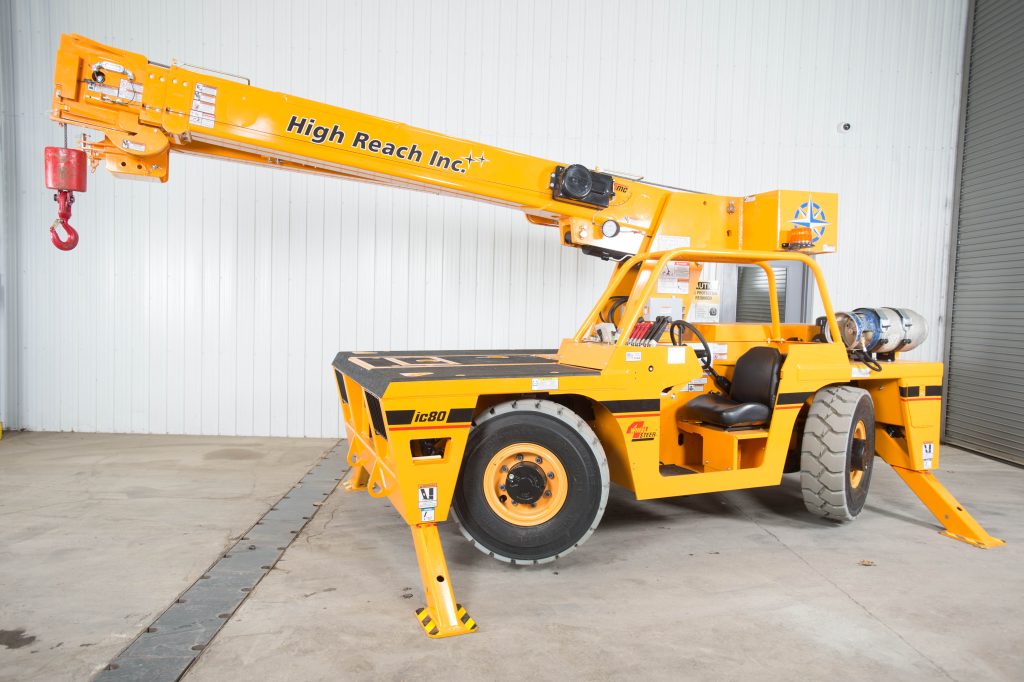
It matters more on carry deck cranes than on almost any other lifting machine, because the whole point of the category is working inside. A rough terrain crane lives in a yard. A carry deck is built low and narrow specifically so it can come through a door and work under a pipe rack, which means the question of what its engine is putting into the air is built into the category.
What a dual fuel carry deck crane actually is
A dual fuel machine carries one engine and two fuel systems, and the operator switches between them. On a carry deck crane that means gasoline or propane, usually written LPG. Propane handles the indoor work. Gasoline covers longer outdoor runs and cold starts.
That is not the same as an aftermarket conversion, and it is not the same as a diesel with an exhaust filter on it. A factory dual fuel machine is built to run properly on either supply, with both systems rated and serviced as part of the crane.
Most machines in a carry deck fleet are straight propane or straight diesel. Dual fuel is the option worth knowing about, because it covers the jobs that move between inside and outside and because you have to ask for it specifically.
Why fuel matters more indoors than people expect
Any combustion engine running inside a building puts exhaust into air that workers are breathing. Ontario deals with this in two places.
Section 127 of Regulation 851 requires that an industrial establishment be adequately ventilated, by natural or mechanical means, so that the atmosphere does not endanger the health and safety of workers. That is a general duty and it sits with the employer who controls the building, not with the rental company.
Ontario’s occupational exposure limit for carbon monoxide is 25 parts per million, measured as an eight hour time weighted average.
In a bay with limited air changes, a running engine gets there faster than most people assume.
Propane burns cleaner than gasoline or diesel and produces considerably less carbon monoxide for the same work, which is the reason propane dominates indoor lift equipment. But cleaner is not clean. A propane engine that is out of tune, or one left idling near a fresh air intake, can still push carbon monoxide past the limit in an enclosed space. Choosing the right fuel reduces the problem. It does not remove the need for ventilation or for someone watching the air.
Where each fuel wins

| Fuel | Where it wins | The trade-off |
|---|---|---|
| Propane (LPG) | Enclosed work. Food and beverage plants, pharmaceutical facilities, warehouses with modest air handling, and anywhere the crane idles inside for long stretches. | Shorter run time per cylinder, and the site needs somewhere compliant to store them. |
| Diesel | Outdoors. Yard work, construction sites, long shifts and cold winter starts. | Many plants ban it inside outright, regardless of ventilation. |
| Dual fuel | Jobs that cross between the two, which in plant maintenance is most of them. One crane, one mobilization, no compromise at either end. | You have to ask for it, because most of a fleet will not be dual fuel. |
A shutdown that starts with offloading in the yard and finishes with a motor change inside is the case dual fuel is built for. So is a machine move that runs from a loading dock, down a corridor and into a production bay, or an equipment install that spends the morning outside and the afternoon indoors.
Five things to settle before the crane arrives
- Does the plant allow diesel inside at all?Many food and pharmaceutical sites ban it outright regardless of ventilation, which leaves propane or dual fuel as the only options.
- Where will the propane cylinders be stored?Supply is not something you need to arrange. We provide the tanks with every propane rental unless you specifically ask us not to. Storage on site is still worth a look, because a plant that has never run propane equipment may have nowhere compliant to put a spare.
- Is anyone measuring carbon monoxide in the work area?If the answer is no and the work is enclosed and lengthy, raise it with the plant’s health and safety representative before the machine is booked rather than after.
- How long will the crane run between refuels?Run time on a propane cylinder is shorter than on a gasoline tank. On a long indoor shift that means asking us for spares up front rather than discovering the shortfall halfway through a lift.
- Where will the machine actually sit?An exhaust parked under a fresh air intake or in a dead corner undoes a good fuel choice.
Fuel does not pick the crane
Worth saying plainly, because it is a common mistake. Capacity, working radius, travel height and width still decide which machine can do the job. A dual fuel crane that cannot make the lift is no use, and neither is one that cannot get through the door.
Specify the machine against the lift first. Then ask whether the fuel on it suits the space it has to work in. For most indoor plant work in Ontario that points to propane or dual fuel, and knowing it at the booking stage rather than on delivery day is the difference between a clean maintenance window and a crane sitting in the yard.
Tell us about the space, not just the tonnage
Most of our fleet runs propane or diesel, and a good number of our machines are dual fuel, switching between gasoline and propane as the job moves inside and out. Tell us where the crane has to work and how well the space is ventilated.
High Reach Inc. · 480 Wyecroft Rd, Oakville, ON L6K 2G7