Equipment guide
Most plants have an overhead crane. It covers the bays it was built to cover, and it does that well. The problem arrives when the lift is outside its hook coverage, heavier than its rating, or in a building that never had one.
At that point there are three realistic options, and the differences between them are more practical than technical. This guide covers what actually separates a carry deck crane, a mobile crane and an overhead crane for indoor work, how to tell quickly which one your job needs, and the Ontario certification threshold that catches people out.
The short version
| Machine | Best when |
|---|---|
| Overhead crane | The lift sits inside existing hook coverage and within the rated capacity |
| Carry deck crane | The lift is indoors, outside hook coverage, and the load has to travel |
| Mobile crane | The lift is heavy or high enough that neither of the above reaches, and the building can accommodate the machine |
The rest of this explains why, and where the boundaries actually sit.
Overhead cranes: excellent within their envelope, useless outside it
An overhead crane is the cheapest lift you will ever make, because the capital cost is already spent. Where the load sits under the hook and inside the rating, nothing else competes.
Two things take it off the table. The first is coverage. The hook travels the bridge and the bridge travels the runway, and that rectangle is fixed. Anything outside it, including the receiving dock, the yard door, and usually the maintenance bay, is out of reach.
The second is what happens when the crane itself is the problem. If the overhead crane is down for inspection or repair, or the lift is the crane component, you need a machine that can operate underneath it.
An overhead crane moves loads within the building.
It does not bring them in.
Carry deck cranes: built for the space between
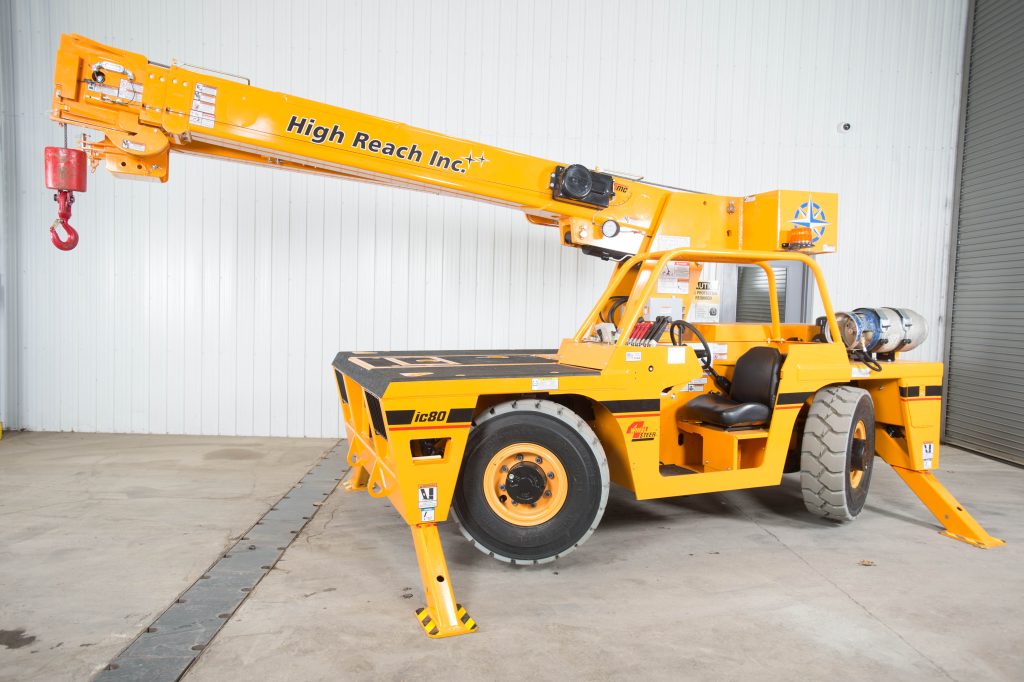
A carry deck crane is a compact, self-propelled crane with a 360° rotating boom mounted over a flat load deck. That combination is the whole point.
The rotating boom means it can pick from one side and set on the other without repositioning. The deck means the load rides with the machine, so a single unit can collect a component at the door, carry it down the aisle, and place it on the foundation. On a job that would otherwise need a forklift and a crane, it needs one machine and one operator.
The dimensions are what make it work indoors. These machines are built low enough to travel through plant doorways and work in bays where a conventional mobile crane cannot get set up, let alone rotate.
Where a carry deck fits:
- Machinery installation and removal inside an existing building
- Maintenance lifts outside overhead crane coverage
- Work underneath an out-of-service overhead crane
- Confined areas where a mobile crane cannot deploy outriggers
- Jobs where the load has to travel as well as be lifted
A carry deck crane has two ratings, not one.
Set up on outriggers it lifts substantially more than it can pick and carry on rubber. Both figures are on the load chart and the difference between them is large. Size the job to the number that matches how you will actually work.
Mobile cranes: capacity and height, at the cost of footprint
When the load exceeds what a carry deck can take, or the lift height is beyond its boom, a mobile crane is the answer. The trade is space and setup.
A mobile crane needs room to deploy outriggers, and the outrigger footprint is considerably larger than the machine. It needs headroom for the boom at working angle, which is not the same as headroom for the machine at rest. Inside a building, that combination frequently rules it out regardless of whether the capacity is right.
The other consideration is time. A mobile crane set up for a single pick can spend longer arriving and rigging than lifting, which matters when the whole job runs inside a shutdown window.
The Ontario certification threshold, and why it changes the machine you pick
This is the part most equipment comparisons leave out, and it can decide the job.
In Ontario, any mobile crane rated over 16,000 lbs, which is 8 tons, requires a certified operator.
At or below that rating, no certificate is required.
That single line has a practical consequence that surprises people. Only the three smallest machines in the Broderson range sit below the threshold. From the IC-80 upward — including the most widely used model in the range — a certified operator is required.
| Broderson model | Rated capacity | Certified operator |
|---|---|---|
| IC-20 | 2.5 ton (5,000 lb) | Not required |
| IC-35 | 4 ton (8,000 lb) | Not required |
| IC-40 | 4.5 ton (9,000 lb) | Not required |
| IC-80 | 9 ton (18,000 lb) | Required |
| IC-100 | 10 ton (20,000 lb) | Required |
| IC-200 | 15 ton (30,000 lb) | Required |
| IC-250 | 18 ton (36,000 lb) | Required |
| IC-280 | 20 ton (40,000 lb) | Required |
| IC-400 | 25 ton (50,000 lb) | Required |
| RT-400 | 20 ton (40,000 lb) | Required |
The threshold is the machine's rated capacity, not the weight of the load you happen to be lifting on the day. Renting a 10 ton crane to move a 6,000 lb load still puts you above the line.
Worth knowing that a carry deck crane carries two ratings. The IC-80 lifts 18,000 lb on outriggers but 11,400 lb picking and carrying on rubber. The figures above are the machine's rated capacity, which is the number the requirement is written against. If you are unsure how that applies to a specific job, ask us and ask your health and safety lead before the machine arrives.
The IC-80 is worth singling out. Broderson describe it as the most popular compact pick and carry deck crane in the industry, and at 18,000 lb it sits above the threshold. It is the machine people most often assume needs no certificate, and it does.
Three situations where this catches people out:
- A job moves up a size bracket year over year, and the machine that needed no certificate last time now does
- A crew sizes up “to be safe” on capacity, and unintentionally crosses into certified territory
- The requirement is discovered on the morning of the lift, when the certified operator is not available
If your team is not certified and the job genuinely needs the capacity, the answer is usually to arrange an operator with the machine rather than to undersize the crane. Confirm the requirement with your supplier and your health and safety lead when you book, not when the truck arrives.
Four questions that settle it
- Where does the load start and finish?If both points sit under the existing hook, use the overhead crane. If the load has to travel between bays or come in from outside, an overhead crane cannot do it at all.
- What is the lowest clearance on the route?Not the ceiling height. The doorway, the pipe run, the mezzanine edge, the point where the machine turns. This is where a mobile crane usually fails an indoor job.
- What does the floor carry?Machine weight spread across tyres is one figure. Outrigger point load is a much higher one over a much smaller area. On mezzanines, over basements, or on older slabs, get the floor loading confirmed before the machine arrives.
- Does the load need carrying, or only lifting?If it needs to move any distance, a carry deck does in one operation what otherwise takes two machines.
What we carry
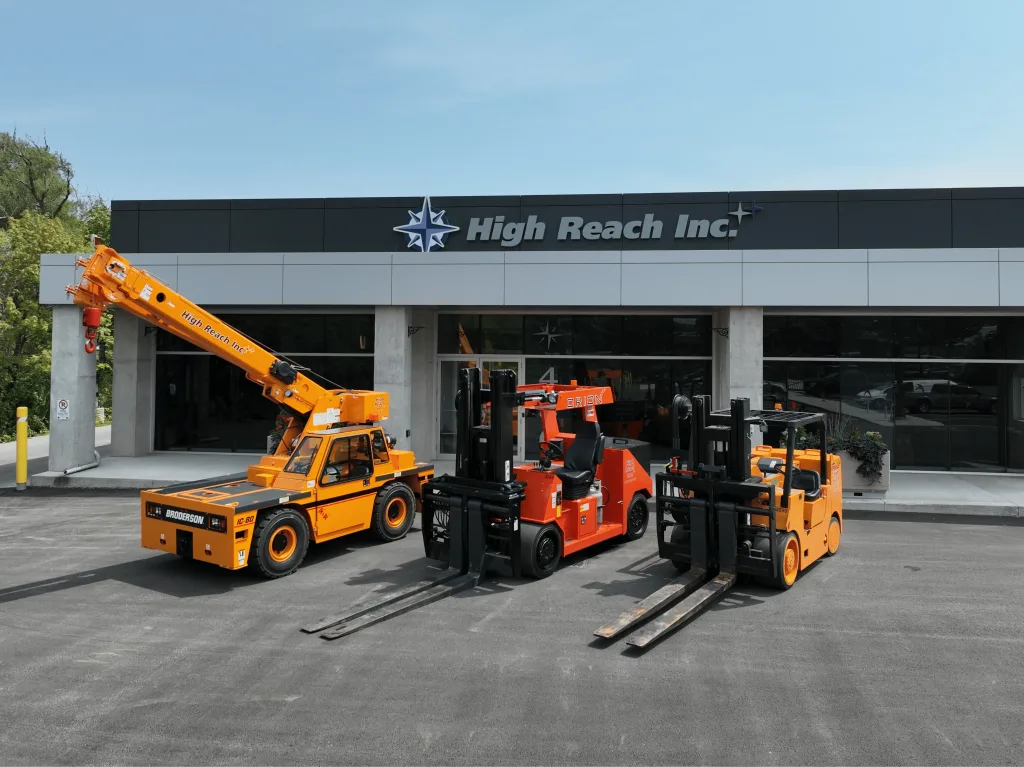
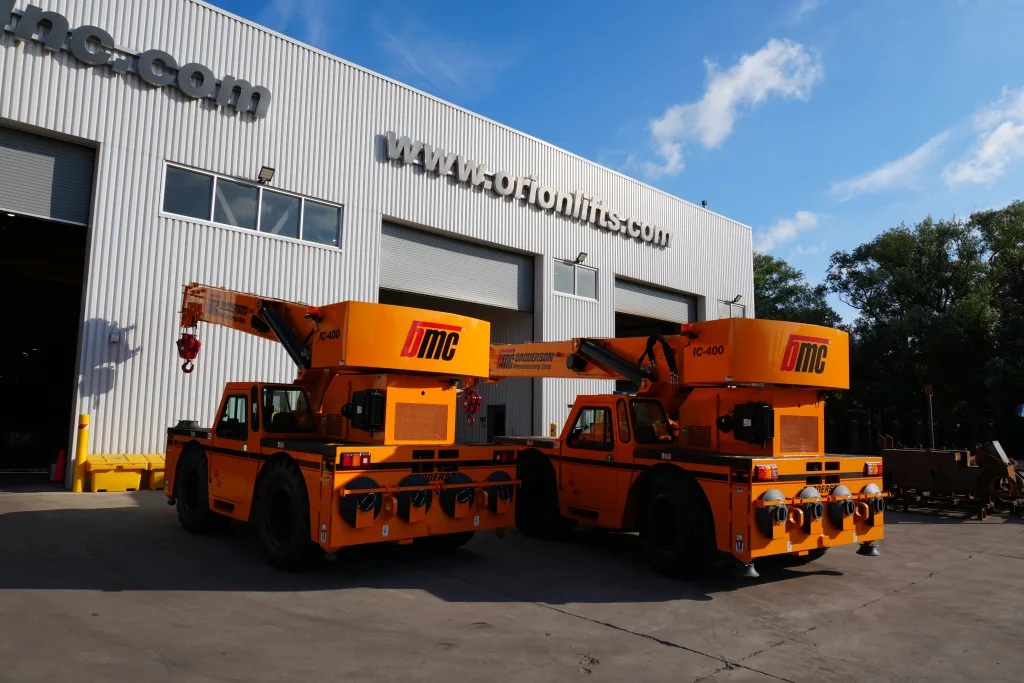
High Reach supplies Broderson carry deck cranes across Ontario, from 2.5 ton to 25 ton, for rental and purchase. Ten models, all with published load charts and dimensions, and we will tell you which side of the certification threshold each one sits on before you book it.
If the lift is beyond a carry deck, we will say so rather than sell you the wrong machine. Tell us the weight, the dimensions, where it has to go and what is in the way, and we will size it with you.
Not sure which machine the job needs?
Tell us the weight, the dimensions, where it has to go and what is in the way. We will size it with you, and tell you whether a certified operator is required.
High Reach Inc. · 480 Wyecroft Rd, Oakville, ON L6K 2G7