Planning guide
A crane that performs well on a plant floor can be the wrong machine underground. Capacity is rarely what decides it.
Headroom, ventilation, floor conditions and the route to the working face narrow the shortlist first. Capacity is usually the last thing you confirm rather than the first thing you ask about, and jobs go wrong when that order gets reversed.
Headroom decides the shortlist before capacity does
Underground, the drift decides the machine. Haulage drifts have finite space and almost none of it is empty. Ventilation ducting, water lines, power cables and communications all take their share of the clearance, and what is left is what the crane has to pass through.
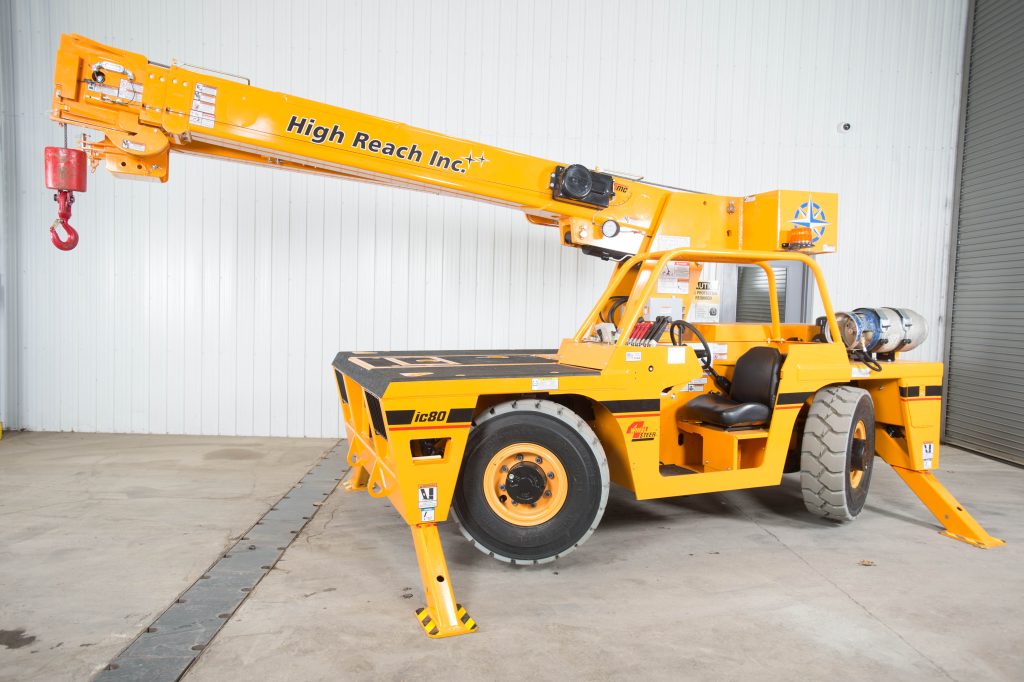
Carry deck cranes work well in this environment because the boom stows along the deck rather than standing up over the machine, which keeps travelling height close to machine height. That one design decision is why the category exists underground at all.
Measure the lowest point along the entire route the machine will travel, including every point where it has to turn.
The tightest clearance is rarely at the working face. It is usually somewhere in the middle of the haul, at a junction, or under a duct run.
Ventilation is a bigger constraint than most expect
An engine running underground is competing with a ventilation system that was designed around an existing fleet. Adding a machine changes that calculation, and it is the mine’s ventilation engineers who have to live with the result.
This is why fuel type is a design requirement underground rather than a preference. Airflow is limited and emissions matter accordingly. LPG burns considerably cleaner than diesel, which is why LPG and dual fuel configurations are common on machines destined for confined spaces.
Ask any supplier for engine specifications and emissions data early in the conversation. If they are unfamiliar with mining work it can take time to produce, and that is worth discovering at the enquiry stage rather than two weeks before the machine is needed.
What the ground carries
Underground floors are muck, backfill, shotcrete or rock. They are not engineered slabs and they do not behave like them.
Two measurements matter and they are different from each other. The first is machine weight distributed across the tyres, which governs whether it can travel. The second is the concentrated point load under the outriggers during a lift, which governs whether it can set up. A machine can traverse a drift safely and still punch through where it deploys, particularly near stope edges or ground that has recently been mucked.
Cribbing and pads are part of the lift plan rather than an afterthought, and their size follows from the actual outrigger loads rather than from whatever happens to be on the truck.
Getting the machine to the working face
The route is its own problem. Ramp gradients, turning radius at intersections, cage or shaft dimensions, and whether a unit can be dismantled and reassembled underground all constrain what is practical.
This is where compact capacity usually beats raw capacity. A smaller machine that fits the existing access routes is frequently worth more than a larger one that has to come apart to get where it is going and then go back together in a drift.
Why carry deck cranes suit this work
Everything above explains why this category keeps coming up in mining. The machines earn their place on four counts.
- Low, narrow build that passes through existing access routes without disassembly
- Boom stows along the deck, keeping travelling height close to machine height
- Full 360 degree rotation from a turret, so the machine rarely needs repositioning
- A load deck that carries rigging, slings and the replacement component on the same trip
- LPG and dual fuel options for confined spaces where diesel is a ventilation problem
The deck earns its place underground more than anywhere else. It turns three trips into one in an environment where every trip is slow and the drift is blocked while you make it. It also lets the operator set a load down on the machine instead of travelling with it suspended, which is both safer and faster.
Surface work has its own constraints
Not all mining lifting happens underground. Headframes, hoist rooms, mills, crushers and shop areas account for a great deal of it, and much of that work happens in buildings designed decades ago for equipment that no longer exists.
Door clearance, floor loading and how far the load has to travel inside the building are what decide the machine there. In Northern Ontario there is a seasonal factor on top of that. From November onward, cold-start performance, hydraulic function and battery condition stop being details and start being the reason a machine does or does not show up ready to work.
Plan the service call before you need it
A crane down underground does not just stop that lift. It blocks a drift and it can stop production behind it, which makes downtime expensive in a way that is hard to compare to surface work.
Settle two questions before the machine arrives rather than on the day it fails. How quickly can a technician attend, and can that technician work underground. Then ask about parts, where inventory is actually held, and whether the supplier is the manufacturer or an authorised dealer, because that usually determines whether a repair takes hours or takes a week.
Working through the decision
In this order, because each step rules things out before you spend time on the next one.
- Measure the routeLowest clearance, tightest turn and steepest gradient along the whole path, not just at the destination.
- Talk to ventilation before you shortlistFuel type and engine rating will constrain your options more than capacity does.
- Establish ground conditions at the lift locationsAsk us for the ground pressure and outrigger point loads on whatever is still on the list, then have your lift planner check them against what the ground will actually take.
- Confirm load weight, dimensions and lift radiusCapacity is checked here, against a shortlist that already fits.
- Settle service and parts coverDo it before the machine is deployed rather than after it stops.
The mining cranes we supply
High Reach supplies Broderson carry deck cranes throughout Ontario, including the northeast, for both surface and underground operations. Their compact geometry and LPG options are what make them suitable here.
| Model | Capacity | Typical mining use |
|---|---|---|
| IC-20 | 2.5 ton | Tight drifts and confined maintenance work |
| IC-35 | 4 ton | General underground lifting |
| IC-80 | 9 ton | Heavier underground work and surface lifting |
| IC-200 | 15 ton | Mill and hoist room work |
| IC-400 | 25 ton | Surface and heavy component lifting |
We deliver across Northern Ontario and support mining operations around Timmins and the surrounding region, for rental or purchase.
Send us the drift and the load
Lowest clearance on the route, tightest turn, load weight and where it has to end up. That is enough for us to tell you which machines fit, and we will give you the ground pressure figures your lift planner needs for the rest.
High Reach Inc. · 480 Wyecroft Rd, Oakville, ON L6K 2G7