Buyer's guide
Most people approach this as a price comparison. Monthly rental against a purchase figure, work out the crossover, done.
That calculation is usually wrong, because it compares the two things that are easiest to find numbers for and ignores most of what ownership actually costs. Renting or buying a forklift is not really a price question. It is a question of how often the machine will be working.
Utilisation is the real question
A high-capacity forklift that runs every shift is a different proposition to one that comes out for a die change twice a month. Same machine, same price, completely different answer.
Before anything else, work out roughly how many days a year you would actually use it. Not how many days you might want it available. How many days it would have a load on the forks.
Most operations are surprised by how low that number is. A machine bought for a specific project keeps getting justified afterwards on the basis that it is there, which is not the same as it being needed.
What ownership costs beyond the purchase price
The purchase figure is the part everyone models. The rest is where the comparison usually breaks.
| Cost | What it actually means |
|---|---|
| Maintenance | Scheduled service, wear parts, hydraulic and tyre replacement. Real and recurring on a machine of this size. |
| Repairs | Unscheduled, unpredictable, and rising as the machine ages |
| Storage | Indoor space for a machine that may sit for weeks at a time |
| Insurance | On the machine and on its operation |
| Operator training | Required regardless, but on your books rather than the supplier's |
| Downtime | When it fails and you still need the lift done |
| Depreciation | And whatever the residual turns out to be when you sell |
None of those is a reason not to buy. They are simply the numbers that belong in the comparison, and most comparisons leave them out.
Where rental clearly wins
Rental is the straightforward answer when any of these describes the situation.
- The lifting is project-based, tied to an installation, relocation or shutdown
- You need capacity beyond your own fleet a handful of times a year
- The requirement is a one-off and you do not expect it to recur
- You are not sure what size you need, and want to try one before committing
- A machine has failed and production is waiting
That last one is worth its own note. Renting during a breakdown is not a cost comparison at all. It is buying back production hours, and the calculation is entirely different.
Where ownership clearly wins
Buying makes sense when the machine becomes part of how the plant runs rather than something brought in for a job.
- The lifting is routine and predictable through the year
- You need it available at short notice, repeatedly, without waiting on availability
- The configuration is specific to your facility and a standard rental unit does not fit it
- Operators are trained on it and that familiarity has value
- The machine is central enough that not having it stops work
The configuration point is the one people undervalue. A machine specified to your door heights, aisle widths, floor loading and attachment requirements does the job faster and more safely than a general-purpose unit that happens to have the capacity. Over years of daily use, that difference compounds.
The case in between
Most operations that ask us this question are in neither camp. The lifting is more than occasional but less than daily, and both answers look defensible.
Long-term rental usually fits that gap better than either. A machine on site for six or twelve months, with service included, no capital committed, and the option to change size if the requirement turns out different to the forecast. It costs more per month than owning would, and it buys you the ability to be wrong about the forecast without owning the consequence.
It is also the honest answer when nobody can say confidently how much the machine will be used, which is more often than anyone admits.
Work it out on your own numbers
No article can tell you what this costs, because it depends entirely on your utilisation and your facility. What it can do is give you the shape of the calculation, so you are comparing the right things rather than a monthly rate against a purchase price.
Take a year. Then work through four lines.
- Days of actual use.Not days available. Days with a load on the forks. Be honest, and if nobody knows, that answer is itself informative.
- The rental cost of those days.Your supplier can price this in a few minutes, and it is the only figure in the exercise that is easy to get.
- The full annual cost of owning.Purchase price spread over the years you expect to keep it, plus everything in the table above. Service, wear parts, repairs, storage, insurance, and the operator training that sits on your books rather than a supplier's.
- The cost of not having it.What a day of waiting costs when the machine you own is down, and what a day of waiting costs when a rental is not available. These are rarely the same number, and the gap between them is usually the deciding factor rather than either total.
Run that and the answer is normally obvious. Where it is not, the machine is being used often enough to matter but not often enough to justify the capital, and long-term rental is the answer that fits the middle.
Two things people consistently get wrong when they do this.
Line one gets overestimated, because a machine that is available feels busier than it is. Line three gets underestimated, because only the purchase price is easy to find and the rest gets left out. Both errors push the same way, which is why ownership so often looks better on paper than it turns out to be.
Renting or buying a forklift: four questions that settle it
- How many days a year would it be lifting?Not available. Lifting.
- What happens on the day it is down?If the answer is that work stops, availability is worth more than the monthly figure suggests.
- Does a standard machine actually fit your facility?Door heights, aisle widths, floor loading, attachments. If not, ownership starts to look better because you can specify it.
- How confident are you in the forecast?If the honest answer is not very, long-term rental keeps your options open.
What we do either way
We rent and sell across all three lines, which means we have no particular stake in which way you go. That is deliberate. A supplier who only rents will tell you to rent.
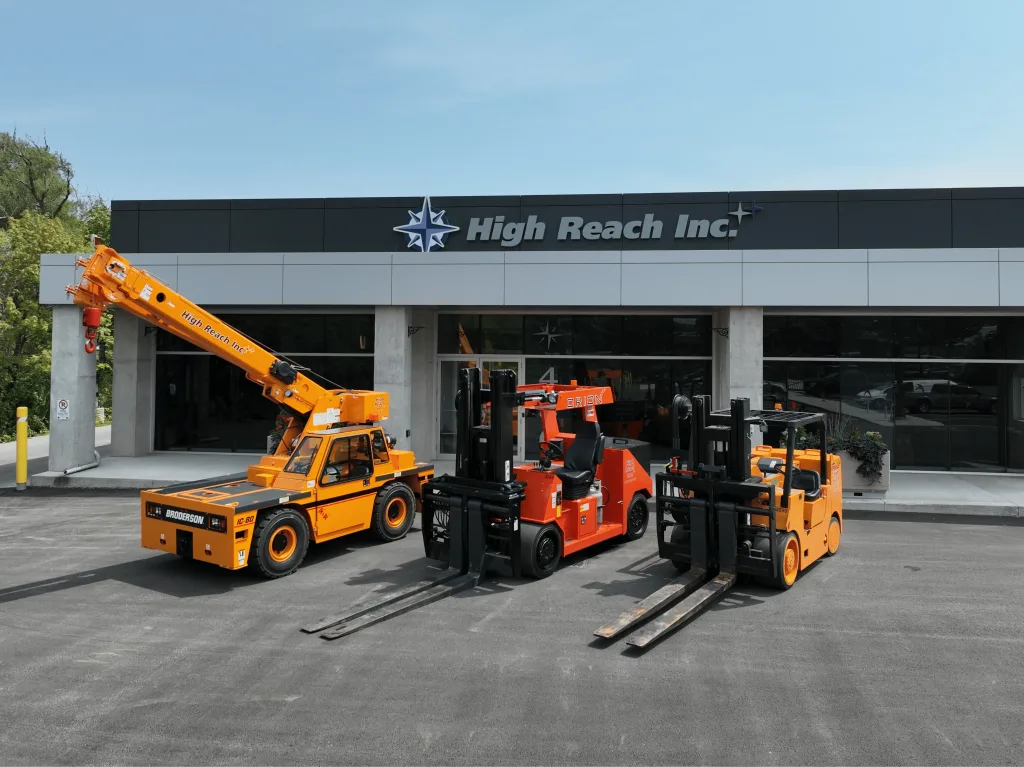
Our ORION line runs from 24,000 lb to 160,000 lb and is designed and built at our own facility in Oakville, so a purchased machine can be configured to your plant rather than to a catalogue. Parts and service come from here rather than an overseas supply chain, which matters more on an owned machine over ten years than it does on a six-week rental.
If you are weighing this up, tell us how often you would use it and what it has to do. We will work through the numbers with you, and we will say so if the answer is rental. If you are already comparing quotes, our guide to what separates rental contracts covers the terms that move the number.
Not sure which way to go?
Tell us how often you would use it and what it has to do. We will work through the numbers with you, and we will say so if the answer is rental.
High Reach Inc. · 480 Wyecroft Rd, Oakville, ON L6K 2G7