Planning guide
A rooftop unit looks like a straightforward lift. It usually is not.
The weight rarely decides it. What decides it is where the crane can stand, how far it has to reach from there, and whether the ground and the roof will carry what you are about to put on them. Get those three wrong and the machine that arrives cannot do the job, which you discover with a crew standing around and a unit on a truck.
This covers what actually governs an HVAC crane rental, and how to work out what you need before you book anything.
Reach matters more than capacity
Every crane has two numbers that matter here, and the headline capacity is not one of them.
The first is how far the load sits from the centre of the machine, the radius. The second is how high it has to go. Capacity falls sharply as radius increases, so a crane rated at 25 ton close in might lift a fraction of that at the reach a rooftop lift demands.
The number that governs is not what the crane can lift.
It is what the crane can lift at the radius and height your job needs.
That is why the first question is never how heavy the unit is. It is how far back from the building the crane has to set up, and how high the roof is. Those two together set the radius, and the radius sets the capacity available. Both are on the load chart, and we will send you the relevant one before you book.
Where the crane can stand
On a commercial or industrial site, the setup position is usually forced by things nobody thinks about until the day.
- Parked vehicles, and whether the lot can be closed for the window you need
- Overhead power, which imposes minimum approach distances and often rules out the obvious spot
- Landscaping, curbs and islands between the lot and the building
- Underground services, tanks, or a basement level beneath the setup area
- Whether the machine can be positioned square to the lift or has to work over the side, which is rated differently
Walk the site and measure from the building face to the nearest position a machine can actually occupy. That distance, plus the setback of the unit from the roof edge, is your radius.
What the ground carries, and what the roof carries
Two separate questions, and both get skipped.
On the ground, the machine's weight spread across its tyres is one figure. The point load under an outrigger when it sets up to lift is a much higher one concentrated onto a much smaller area. Asphalt in summer, a slab over a basement, a lid over a service trench, or backfill near a recent excavation are all places where a crane can travel safely and then punch through where it sets up. Cribbing and pads are part of the lift plan, and their size follows from the outrigger load rather than from what happens to be on the truck.
On the roof, the question is what the structure takes at the landing point. A packaged rooftop unit concentrates its weight onto a small number of curb or rail contact points, and where it lands is rarely where the structural engineer assumed. If the unit is going somewhere new rather than replacing like for like on an existing curb, that is a question for whoever holds the structural drawings, before the lift rather than after.
The window
Rooftop work almost always runs to a fixed window, and usually a short one. The building is occupied, the lot has to reopen, the old unit is coming off the same day the new one goes on, or the tenant has agreed to a specific morning.
That changes what matters in a machine. A larger crane with more reach is worth little if setting it up eats half the window. A machine that can be positioned and rigged quickly, and that does not need a separate transport to bring the unit across the lot, often beats a bigger one on the clock. The same logic applies to any job with a fixed window.
It also changes what matters in a supplier. Ask what happens if the machine will not start on the morning, because on a fixed window that is the difference between a delay and a cancelled job.
What an HVAC crane rental gets you here
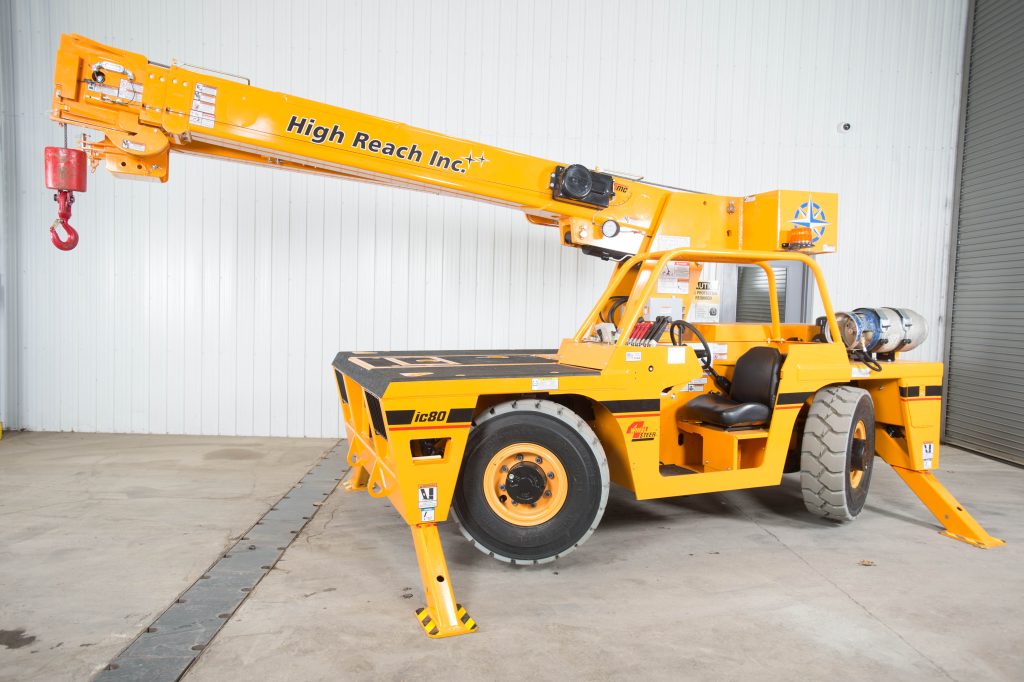
Carry deck cranes cover more of this work than their compact footprint suggests. The IC-400 is rated to 25 ton and carries a substantial boom, which puts multi-storey and longer-reach rooftop lifts within range as well as the single-storey plant work these machines are best known for. What decides it is the combination of weight, height and radius rather than the category of building.
So do not rule the job out on the building. Send the numbers and we will tell you what reaches it. Plant and warehouse work where the roof is modest and the lot allows a machine close in is the straightforward end of this, but it is not the limit of it.
What we need to size it
Five things, and with them we can tell you what fits before anyone books a crew.
- Unit weight and dimensions.From the equipment schedule or the manufacturer, not an estimate.
- Roof height.To the landing point, not the parapet.
- Distance from the nearest possible setup position to the landing point.This is the radius, and it is the number most quotes are missing.
- What the setup area is.Asphalt, concrete, over a basement, near a trench.
- The window.How long you have, and whether the old unit is coming off the same day.
If you have a site plan or a photo of the lot from the building face, send it. It answers most of the above faster than a description does.
Get it looked at early
The rooftop lifts that go wrong are almost never the ones where the crane was too small. They are the ones where nobody measured the radius, or nobody asked what was under the setup area, or the window was set before anyone checked how long rigging would take.
Send us the five things above and we will tell you what reaches it, what does not, and what it will take to do it safely.
Send us the five numbers
Unit weight, roof height, distance from the setup position, what the ground is, and the window. That is enough for us to tell you what reaches it.
High Reach Inc. · 480 Wyecroft Rd, Oakville, ON L6K 2G7